
Soybean Breeding Technology Innovation and New Varieties Breeding
Date:2014-07-23Author:AdminSource:ICS
Team Name: Soybean Breeding Technology Innovation and New Varieties Breeding
Research Focus: carrying out soybean molecular breeding technology research, establishing a new system soybean breeding system integrating molecular tools with conventional techniques, improving soybean breeding collaboration network, improving base facilities, and enhancing precise germplasm exploration and identification and enhance breeding efficiency; creating new breeding materials with outstanding adaptability, yield, quality and stress tolerance; developing new soybean varieties applicable to large-scale planting in Huang-Huai-Hai areas and northeast soybean producing areas; constructing new varieties breeding, exhibition and demonstration bases, strengthening supporting cultivation technology research, and accelerating the application of new varieties and technologies.
Research Objectives: to enhance the genetic research on soybean adaptability, yield and quality traits, initially to establish a modern breeding technology system combining conventional and molecular techniques, and continuously improve breeding efficiency; to breed new varieties of soybean that could play a leading role in the main producing areas, develop supporting cultivation techniques, and continuously expand the area of adaptation.
Team Chief Scientist: Dr. HAN Tian-fu
Education Background
HAN Tianfu, a soybean breeder, received his BSc degree in Agronomy (1984) from Gansu Agricultural University, China, his MS degree in Crop Cultivation and Farming System (1988) and Ph.D degree in Crop Genetics and Breeding (1994) from the Northeast Agricultural University, China. He completed his postdoctorate research in 1997 at Nanjing Agricultural University, and he also worked at Chinese University of Hong Kong (2000) and Pennsylvania State University, USA (2002), as a visiting scholar.
Research Area
Dr. Han’s primary research responsibilities are in soybean breeding, physiology and genetics. The major objectives of the research are to identify and improve the photo-thermal adaptability of soybean cultivars through genetic, physiological, and molecular approaches and develop cultivars with other desirable traits. Up to 2013, he has published over 140 papers or chapters and has released 16 soybean varieties approved by the Ministry of Agriculture (MOA) and provincial governments. He also leads the national soybean research and extension projects with the aim of improving the farming system for efficient production and sustainable development of soybean industry in China.
Honors and Awards:
Dr. Han was given a prize of “Best Ten Youth” (1999) by CAAS. He was also rewarded by MOA as “National Advanced Individual for Agricultural Sci-Tech Extension” (2004), “National Advanced Agricultural Researcher” (2005), “National Excellent Individual for Agricultural Sci-Tech Extension” (2007) and “Outstanding Talent for Agricultural Research” (2011).
Selected Publications (total over 140)
·Qin P, W Song, X Yang, S Sun, X Zhou, R Yang, N Li, W Hou, C Wu, T Han*, G Ren*. Regional distribution of the protein and oil compositions of soybean cultivars in China, Crop Science, 2014, accepted, (* corresponding author)
·Jiang B, Yue Y, Gao Y, Ma L, Sun S, Wu C, Hou W, Lam H-M, Han T*. GmFT2a polymorphism and maturity diversity in soybeans. PLoS ONE, 2013, 8(10): e77474. doi:10.1371/journal.pone. 0077474 (* corresponding author)
·Na X, B Jian, W Yao, C Wu, W Hou, B Jiang, Y Bi, T Han*. Cloning and functional analysis of the flowering gene GmSOC1-like, a putative SUPPERSSOR OF OVEREXPRESSION CO1/AGAMOUS-LIKE 20 (SOC1/AGL20) ortholog in soybean. Plant Cell Reports, 2013, 32(8): 1219-1229. (* corresponding author)
·Song S, W Hou, I Godo, C Wu, Y Yu, I Matityahu, Y Hacam, S Sun, T Han*, R Amir*. Soybean seeds expressing feedback-insensitive cystathionine 1 γ-synthase exhibit higher content of methionine. Journal of Experimental Botany, 2013, 64(7): 1917-1926. (* corresponding author)
·Sun H, Z Jia, D Cao, B Jiang, C Wu, W Hou, Y Liu, Z Fei, D Zhao, T Han*. GmFT2a, a soybean homolog of FLOWERING LOCUS T, is involved in flowering transition and maintenance. PLoS ONE, 2011, 6(12): e29238. doi:10.1371/journal.pone.0029238 (* corresponding author)
·Cao D, W Hou, W Liu, W Yao,C Wu, X Liu*, T Han*. Overexpression of TaNHX2 enhances salt tolerance of 'composite' and whole transgenic soybean plants. Plant Cell, Tissue and Organ Culture, 2011, 107: 541-552 (* corresponding author)
·Cheng L, Y Wang, C Zhang, C Wu, J Xu, H Zhu, J Leng, Y Bai, R Guan, W Hou, L Zhang, T Han*.
Genetic analysis and QTL detection of reproductive period and post-flowering photoperiod responses in soybean. Theoretical and Applied Genetics, 2011, 123 (3): 421-429 (* corresponding author)
·Yan J, C Wu, L Zhang, P Hu, W Hou, W Zu, T Han*. Long-day effects on the terminal inflorescence development of a photoperiod-sensitive soybean [Glycine max (L.) Merr.] variety. Plant Science, 2011, 180 (3): 504-510 (* corresponding author)
·Jian B, W Hou, C Wu, B Liu , W Liu, S Song, Y Bi, T Han*. Agrobacterium rhizogenes-mediated transformation of Superroot-derived Lotus corniculatus plants: a valuable tool for functional genomics. BMC Plant Biology, 2009, 9:78 doi:10.1186/1471-2229-9-78 (* corresponding author)
·Cao D, W Hou, S Song, H Sun, C Wu, Y Gao, T Han*. Assessment of conditions affecting Agrobacterium rhizogenes-mediated transformation of soybean. Plant Cell, Tissue and Organ Culture, 2009, 96: 45-52 (* corresponding author)
Academic Membership
Dr. Han is the chief soybean scientist of China Agriculture Research System (CARS), the head of the MOA Soybean Expert Advisory Group, the director of the MOA Key Laboratory of Soybean Biology (Beijing), and the chairman of the Soybean Specialty Committee, Crop Science Society of China. He was a member of the Standing Committee, World Soybean Research Conference (WSRC) from 2003 to 2013.. In 2013, he was selected as the chief scientist of the CAAS Innovation Team for Soybean Breeding Technology and Variety Improvement.
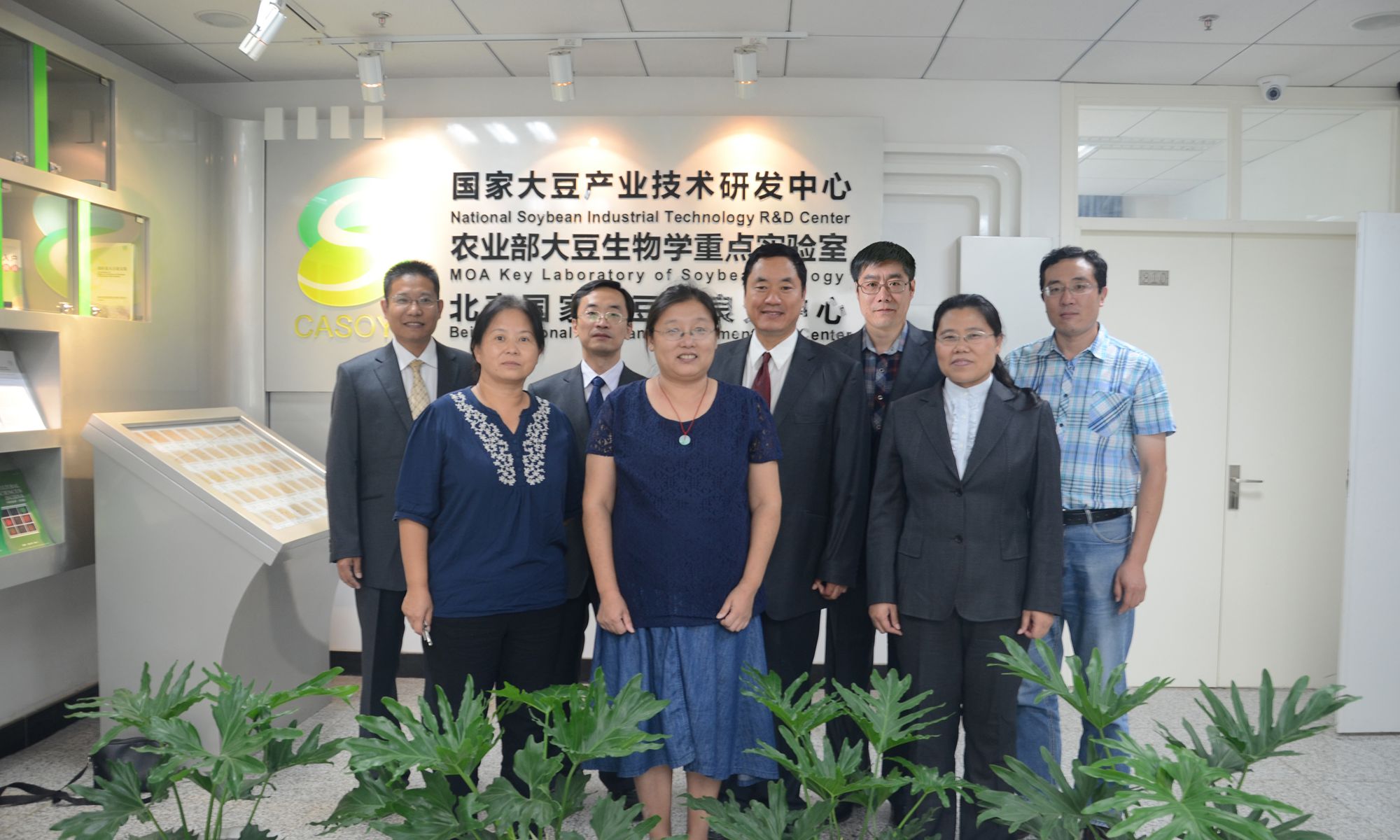
Team Members: HAN Fen-xia, SUN Jun-ming, HOU Wen-sheng, WU Cun-xiang, LI Ji-cun, WANG Lan, SUN Shi, YAN Shu-rong, JIANG Bing-jun, LI Bin, GAO Le.

Address:No.12 Zhongguancun South St.,Haidian
District, Beijing, P.R.China 100081
Tel: +86-10-82105813
Email:zuokesuo@caas.cn
Fax:+86-10-82105819