
Sharing Rice Harvests and a Common Path in the Lancang–Mekong Region—ICS-CAAS Hosts Exchanges and Cooperation on the Lancang–Mekong Rice Industry
On March 26, the 2026 Lancang–Mekong Rice Industry Exchange and Cooperation Event was held in Nanning, Guangxi. It was jointly organized by the Institute of Crop Sciences, Chinese Academy of Agricultural Sciences (ICS-CAAS), the Foreign Economic Cooperation Center of the Ministry of Agriculture and Rural Affairs, and the Guangxi Academy of Agricultural Sciences. With industrial cooperation at its core and scientific and technological innovation as the connecting link, the event aimed to address the needs of the rice industries in Lancang–Mekong countries and showcase China’s technological strengths in crop breeding, intelligent agricultural machinery, and digital agriculture, providing fresh impetus for improving agricultural quality and efficiency across the region. Officials and experts attending included Jin Ke, Director General of the Foreign Economic Cooperation Center; Khamtan, Deputy Director General of the Rice Department of Thailand’s Ministry of Agriculture and Cooperatives; Koson, Deputy Director General of the Lao National Agriculture and Forestry Research Institute; Qin Gang, Vice President of Guangxi Agricultural Vocational and Technical University; Prof. Wang Wensheng, Deputy Director General of ICS-CAAS; and Prof. Xu Jianlong of ICS-CAAS.
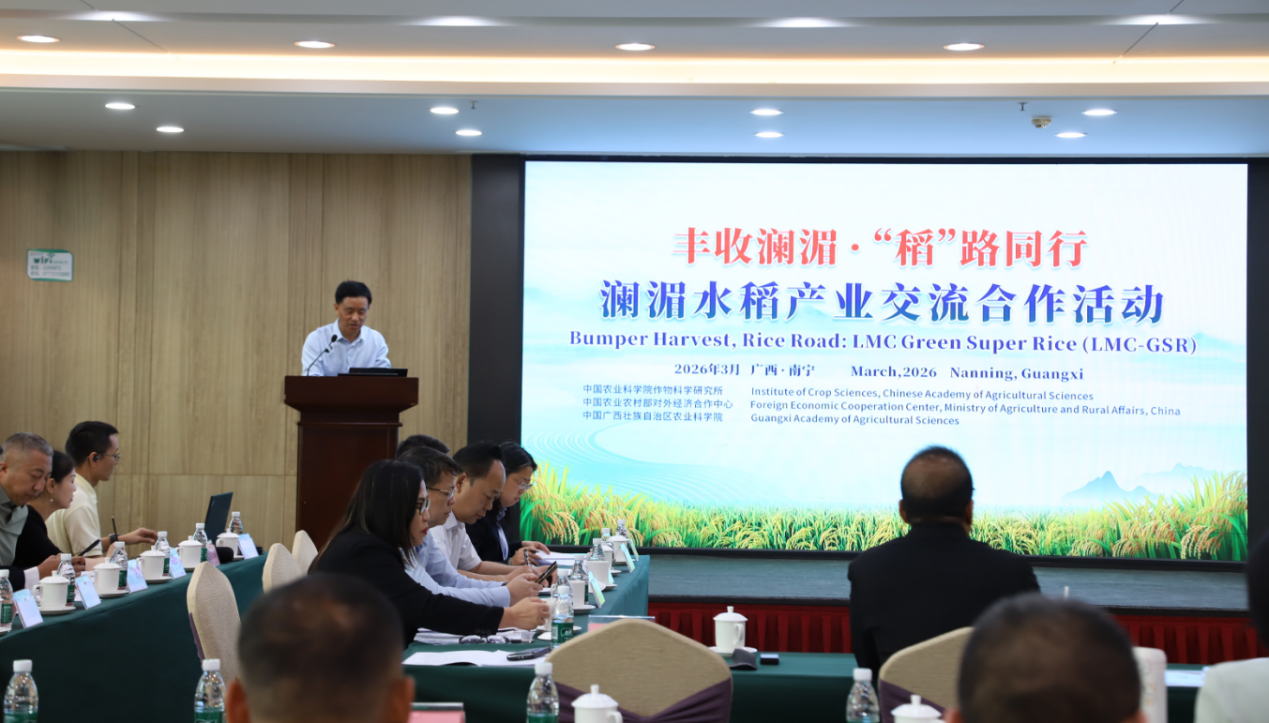
Participants heard detailed presentations by researchers from CAAS, the International Rice Research Institute, Anhui Agricultural University, and other institutions on advances in high-throughput phenotyping, rice–soybean rotation systems, and the application of artificial intelligence and digital technologies. Representatives from Cambodia, Laos, Myanmar, Thailand, and Vietnam introduced the current state of their rice industries, technological needs, and visions for cooperation. Chinese company representatives also presented and discussed improved seeds, intelligent agricultural machinery and equipment, smart agriculture, and cross-border e-commerce platforms for agricultural products. Representatives agreed that rice is a pillar of economic development and food security in the Lancang–Mekong region, where all six countries face shared challenges such as climate change. With its high yields, environmental benefits, efficient use of water and fertilizer, and strong stress tolerance, Green Super Rice has become an important means of transforming traditional agriculture into a higher-value and more sustainable sector. All parties expressed their willingness to continue deepening rice technology exchanges and cooperation with China and to explore new pathways for sustainable agricultural development.
Jin Ke noted that the six Lancang–Mekong countries had achieved substantial results through practical cooperation in rice breeding, efficient cultivation, and environmentally friendly pest and disease management in recent years. As Lancang–Mekong Cooperation enters its new 2.0 phase, he called on all parties to deepen cooperation in seed industry and technological innovation, integration across the rice value chain, and professional training. Such cooperation would support the transition toward a greener, smarter, and more efficient rice industry and provide a solid foundation for stronger regional food security.
Prof. Wang Wensheng noted the considerable potential for increasing rice yields in the Lancang–Mekong region and emphasized that deeper cooperation is an important measure for safeguarding regional food security. The international Lancang–Mekong rice cooperation project led by ICS-CAAS has already achieved initial results in data sharing, variety screening, and personnel training. Its next phase will focus on breeding green rice varieties, demonstrating and disseminating technologies, and integrating related industries to deliver further substantive progress in regional rice cooperation.
During the event, participants also visited Binyang County and Hengzhou, Nanning, to learn about local rice technology innovations, development models, and industrial applications. More than 90 representatives participated in person or online, including officials from agricultural authorities and representatives of international organizations, research and educational institutions, and businesses from Cambodia, Laos, Myanmar, Thailand, Vietnam, Brunei, and other relevant Mekong and ASEAN countries, together with representatives of research institutions and companies from relevant provinces in China.

Address:No.12 Zhongguancun South St.,Haidian
District, Beijing, P.R.China 100081
Tel: +86-10-82105813
Email:zkskyc@caas.cn
Fax:+86-10-82105819