
Tracing the Evolution of 80 Years of Barley Breeding in China and Deciphering the Genetic Code for Early Maturity and Stable Yield
On November 5, 2026, the research team led by Professor Ping Yang from the Institute of Crop Sciences, Chinese Academy of Agricultural Sciences (ICS-CAAS), and the National Key Laboratory of Crop Gene Resources and Breeding, in collaboration with Chinese and overseas research institutions, dissected the genetic background and selection dynamics underlying more than 80 years of barley breeding in China. The study revealed the genetic basis for the coordination of early maturity and stable yield in autumn-sown barley, which is widely grown and plays an important role in double-cropping regions. The findings were published in Nature.
Barley serves as an important raw material for beer brewing, livestock feeding, and is also a staple food in plateau areas such as Qinghai and Xizang. However, China has long been heavily dependent on barley imports. In China, barley is often grown together with wheat, and in rotation with summer crops such as rice to form a double-cropping system. This cultivation system could efficiently raise the multiple cropping index of limited farmland. However, this system features a narrow window of sowing time and a tight transition between the two crops, making it especially vulnerable to extreme weather. Although early-maturing varieties can extend the transition window, they are often accompanied by decreased biomass and yield reduction. Therefore, it is of great practical significance to coordinate the early maturity and stable yield in barley, as well as exploring the potential of applying these mechanisms in genetic improvement of wheat. These efforts would be helpful in enhancing the resilience of double-cropping systems and safeguarding regional food security.
Tracing 80 Years of Breeding History to Clarify the Integration of Barley Germplasm in China
Over a decade, the research team carried out whole-genome resequencing of 532 representative Chinese barley varieties, with years of release spanning the 1940s to the 2010s, together with several foreign varieties as external controls. Combined with phenotypic evaluation through multi-year and multi-location field trials, the team constructed a “selection map” for Chinese barley breeding. This study revealed that the European malting barley with high yield and high quality was introduced to China from the mid-20th century, and has since been continuously integrated with local barley germplasm and adaptively improved. This process has ultimately generated a germplasm panel with both high yield potential and adaptability to local environments, laying the genetic foundation for modern Chinese varieties of malting barley and feed barley.
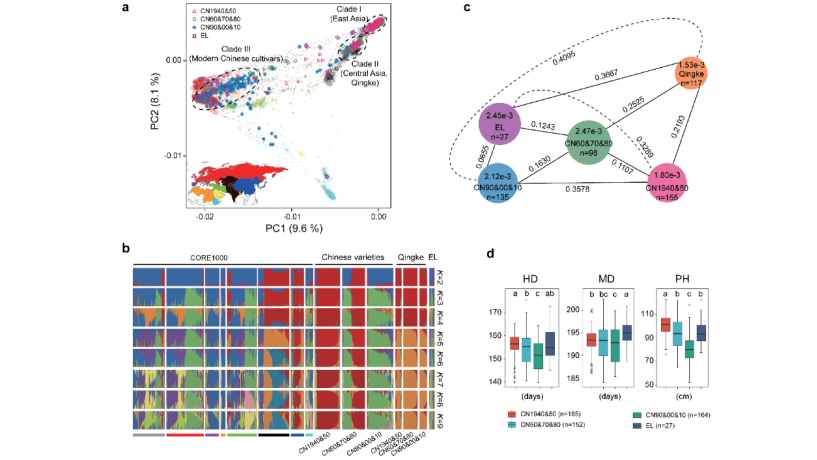
Figure 1. Population structure and adaptive phenotypic changes of Chinese barley varieties in the context of global barley germplasm resources
Identification of the “accelerator” and “brake” gene module and dissection of the molecular mechanism balancing early maturity and stable yield
The researchers detected a pleiotropic locus that simultaneously controls heading date, maturity date, plant height and yield-related traits. This locus harbors two key genes in the photoperiod and vernalization pathways of flowering regulation: the phytochrome gene PhyC and the vernalization gene VRN-H1. This study showed that the early-flowering allele PhyC-e, derived from a single-base mutation in PhyC, can significantly promote flowering under long-day conditions. In spring genetic backgrounds, this mutation accelerates flowering and maturation, leading to insufficient biomass accumulation and reduced yield. By contrast, the winter-type vrn-H1 gene requires low-temperature induction for substantial upregulation of its expression. Therefore, the gene module formed by tight physical linkage between the early-flowering PhyC-e and winter-type vrn-H1 ensures sufficient duration of vegetative growth and biomass accumulation before overwintering. Meanwhile, it accelerates flowering initiation under long-day conditions in spring, enabling barley to mature before the high temperatures and rainy season in early summer. In this scenario, PhyC-e acts as an “accelerator” for flowering, while vrn-H1 functions as a “brake”. Together, they coordinate the photoperiod and vernalization pathways to fine-tune flowering time, reconciling early maturity with stable yield in barley.
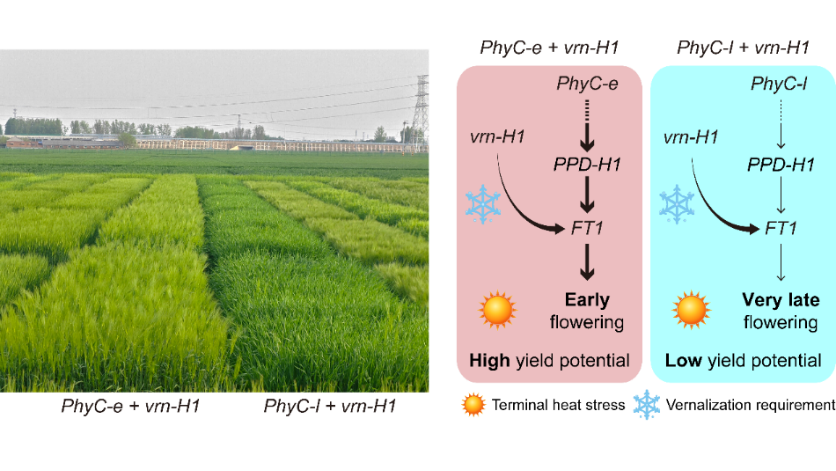
Figure 2. Functional mechanism of the PhyC-e + vrn-H1 module in early maturity and stable yield
The elite phenotypic performance conferred by this gene module has been under continuous selection in modern Chinese barley breeding. Since the 1990s, barley varieties carrying this module have become predominant in the autumn-sowing areas along the middle and lower reaches of the Yangtze River, and the genetic mechanism underlying this superior trait was elucidated in this study.
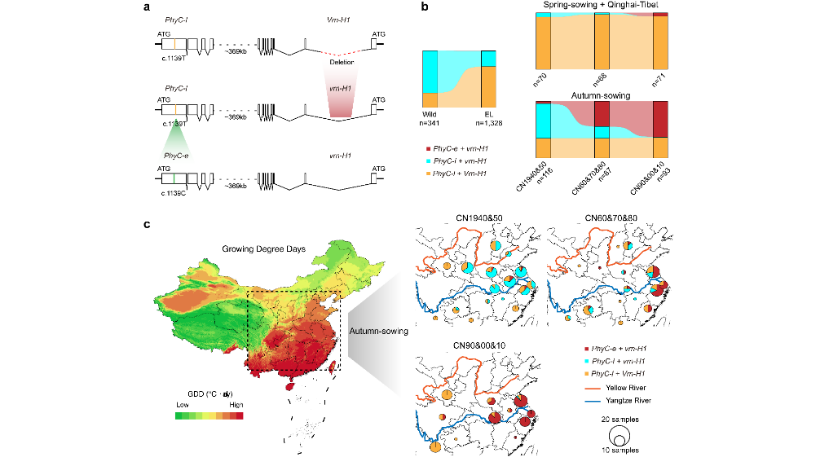
Figure 3. Evolution and selection of the PhyC and VRN-H1 haplotype module in Chinese barley breeding
Precise Single-Base Editing of the Key Regulator Reveals Its Application Potential Across Species
The researchers further employed base-editing technology to precisely edit the PhyC gene in spring barley, generating a PhyC-e variant. The resulting variant successfully phenocopied the early-flowering and early-maturing performance conferred by PhyC-e, and validated the corresponding regulatory mechanism. In addition, the researchers edited the PhyC orthologs in winter wheat and rice. In wheat, the editing also led to earlier maturity without yield penalty, which provides an important target for breeding novel wheat varieties with early maturity, stable yield and enhanced climate resilience. By contrast, editing of this gene led to delayed flowering in rice, indicating that its function is conserved in Triticeae crops but has diverged in short-day species.
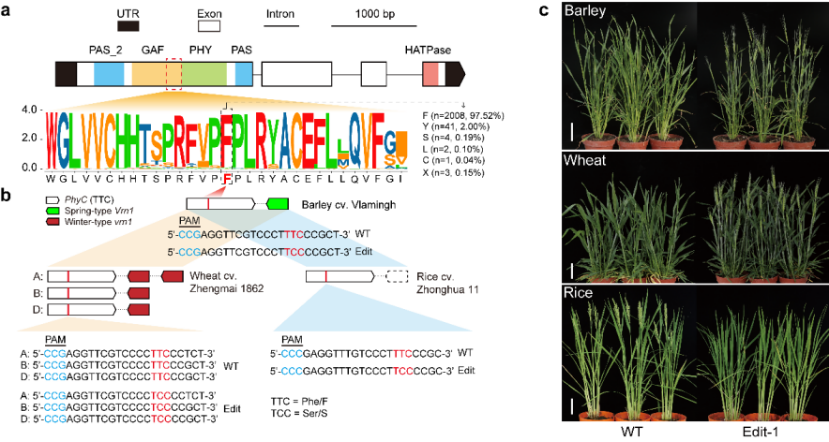
Figure 4. Single-base editing on the key amino acid of PhyC orthologs in barley, wheat and rice
The former PhD student Guangqi Gao, Dr. Congcong Jiang, and PhD student Wenxue Wu from ICS-CAAS are co-first authors of the paper. Professor Ping Yang is the corresponding author. This study was supported by the National Key Laboratory of Crop Gene Resources and Breeding, the Agricultural Science and Technology Innovation Program from CAAS, the Sino-German Mobility Program from the Sino-German Center for Research Promotion, and the National Natural Science Foundation of China.
Link to the article: https://doi.org/10.1038/s41586-026-11187-y

Address:No.12 Zhongguancun South St.,Haidian
District, Beijing, P.R.China 100081
Tel: +86-10-82105813
Email:zkskyc@caas.cn
Fax:+86-10-82105819