
An integrated phenomics and enviromics framework opens the environmental black box in intelligent precision crop breeding
On June 12, the Big Data and Intelligent Breeding by Design Innovation Research Group at the Institute of Crop Sciences, Chinese Academy of Agricultural Sciences (ICS-CAAS), together with Chinese and international research institutions, proposed a new breeding framework integrating phenomics and enviromics. The framework provides a theoretical basis and technical route for data-driven intelligent crop breeding. The work was published in Nature Communications.
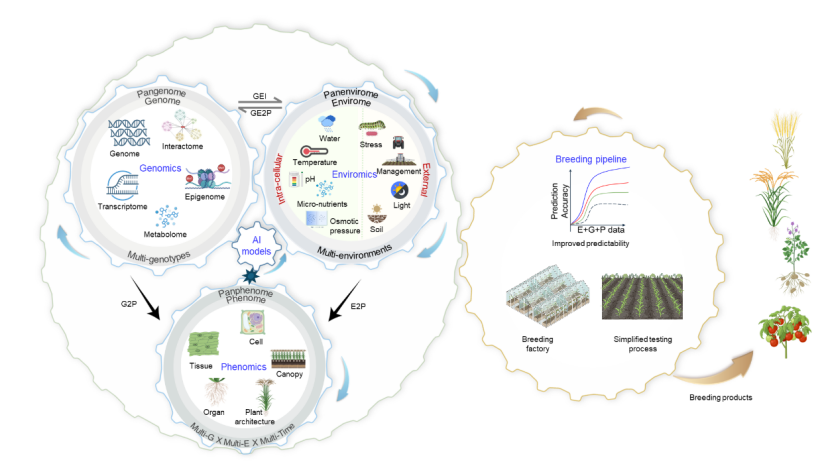
In conventional breeding, environmental factors are often treated as a black box that is difficult to quantify. Crop phenotyping consequently tends to lack detailed environmental data, hindering precise analysis of the relationships among genes, traits, and environments and limiting the rate of genetic gain.
To meet the needs of modern intelligent breeding, the researchers proposed advancing phenomics and enviromics together through high-throughput phenotyping and environotyping, integrated with artificial intelligence and big data analysis. This approach addresses the long-standing separation of crop trait studies from environmental studies and the lack of synchronized observations. The proposed integrated network spans aerial, satellite, ground, and indoor platforms. Satellite remote sensing, unmanned aerial vehicles, autonomous ground equipment, and indoor facilities would jointly collect environmental and phenotypic data across scales throughout the crop life cycle. The framework offers a new perspective and theoretical support for shifting breeding from experience-based selection to precise prediction, accurately predicting complex agronomic traits, and supporting intelligent breeding decisions.
Li Huihui, a research professor, and Gao Shang, an assistant research professor, at ICS-CAAS are co-first authors. Research professors Xu Yunbi and Li Huihui are co-corresponding authors. The work was supported by the National Natural Science Foundation of China, the Agricultural Science and Technology Innovation Program of CAAS, major research tasks of CAAS, and other programs.
Original paper: https://www.nature.com/articles/s41467-026-73097-x

Address:No.12 Zhongguancun South St.,Haidian
District, Beijing, P.R.China 100081
Tel: +86-10-82105813
Email:zkskyc@caas.cn
Fax:+86-10-82105819