
A balanced brake and accelerator mechanism shapes optimal tiller angles in wheat
On April 14, the Wheat Gene Resource Exploration and Utilization Innovation Team at the Institute of Crop Sciences, Chinese Academy of Agricultural Sciences (ICS-CAAS), cloned Rht-A1 and TaLA1-D, two key genes controlling wheat tiller angle. The researchers revealed how these genes balance tiller angle regulation at the transcriptional and protein levels. The findings were published in Nature Communications.
Tiller angle is a core component of wheat architecture that directly affects canopy light-use efficiency and yield. However, the limited identification of genes controlling this trait has constrained efforts to improve plant architecture in wheat breeding.
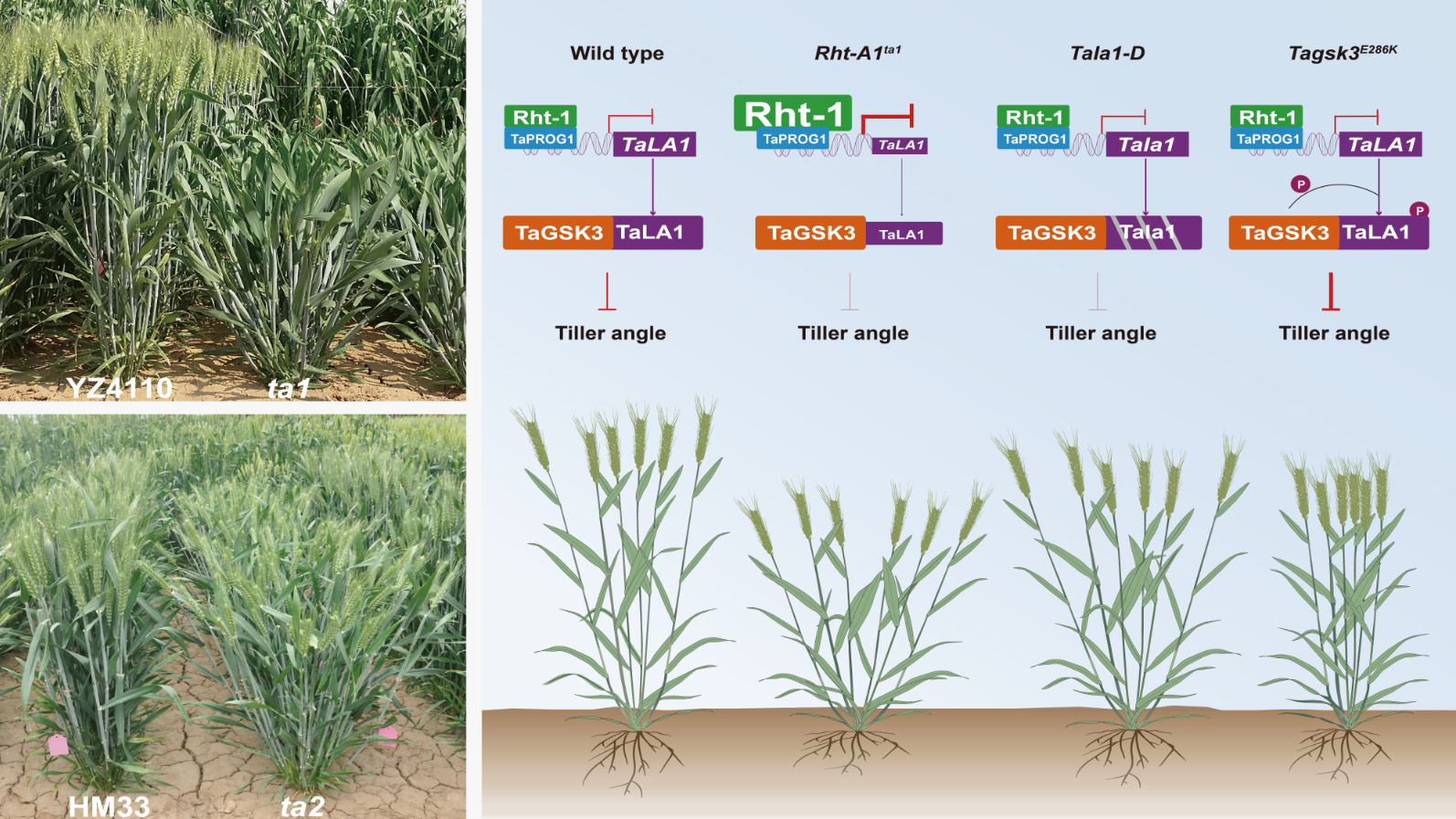
The team identified two mutants with increased tiller angles, ta1 and ta2, from a wheat mutagenesis population and isolated the causal genes, Rht-A1 and TaLA1-D, by map-based cloning. The protein encoded by Rht-A1 interacts with a key plant architecture regulator to jointly repress TaLA1-D transcription, increasing tiller angle. Conversely, a key protein kinase phosphorylates the TaLA1-D protein and increases its stability, reducing tiller angle. These opposing activities form a balanced regulatory mechanism analogous to a brake and an accelerator. Population genetic analysis showed that Hap1, a favorable haplotype of TaLA1-D, reduces tiller angle and increases thousand-grain weight. It has undergone strong selection during the breeding of high-yielding wheat with compact architecture. The study provides a theoretical basis and important targets for optimizing wheat tiller angles and developing high-yielding varieties suited to dense planting.
Chen Yaoyu, a postdoctoral researcher at ICS-CAAS, is the first author. Academician Liu Xu and research professors Zhang Lichao, Kong Xiuying, and Sun Jiaqiang at ICS-CAAS are co-corresponding authors. The work was supported by the Agricultural Science and Technology Innovation Program of CAAS, the National Natural Science Foundation of China, the National Key Research and Development Program of China, and other programs.
Original paper: https://doi.org/10.1038/s41467-026-71872-4

Address:No.12 Zhongguancun South St.,Haidian
District, Beijing, P.R.China 100081
Tel: +86-10-82105813
Email:zkskyc@caas.cn
Fax:+86-10-82105819