
A new deep learning model improves both accuracy and efficiency in crop genomic prediction
On March 26, the Soybean Breeding Technology Innovation and New Variety Development Innovation Team at the Institute of Crop Sciences, Chinese Academy of Agricultural Sciences (ICS-CAAS), developed GP-WAITER, a deep learning model that substantially improves the prediction accuracy and computational efficiency of complex crop traits. The findings were published in Nature Communications.
Genomic prediction uses genotype data to predict phenotypic traits such as crop yield and quality and is important for accelerating modern molecular breeding. However, existing statistical prediction models face challenges including high computational demands, limited biological interpretability, and difficulty capturing long-range interactions among genes.
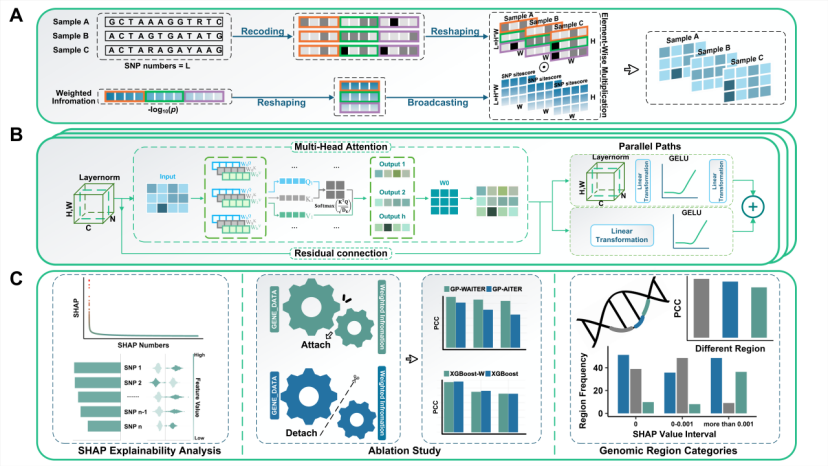
The researchers incorporated variant information from genome-wide association studies as weights in the encoding layer and combined local feature extraction with the ability to capture long-range dependencies. The resulting GP-WAITER model can prioritize important genetic information while efficiently processing very long genomic sequences. Across six groups of datasets, including soybean and maize, prediction accuracy improved by an average of 27.2% over seven widely used models, with a maximum improvement of 77.5%. Computational efficiency improved 1.8- to 2.4-fold, and graphics memory requirements were substantially reduced. Interpretability analyses also identified key genes affecting soybean oil and isoflavone contents. The model provides a powerful tool for accelerating modern molecular breeding.
Li Jing, an associate research professor, and Yu Linfeng, a master's student, at ICS-CAAS, and Li Mengfan, a master's student at the Institute of Environment and Sustainable Development in Agriculture, CAAS, are co-first authors. Research professors Sun Junming and Qiu Lijuan and associate research professor Li Jing at ICS-CAAS are co-corresponding authors. The work was supported by a major national biological breeding program, the National Natural Science Foundation of China, and the Agricultural Science and Technology Innovation Program.
Original paper: https://www.nature.com/articles/s41467-026-71035-5

Address:No.12 Zhongguancun South St.,Haidian
District, Beijing, P.R.China 100081
Tel: +86-10-82105813
Email:zkskyc@caas.cn
Fax:+86-10-82105819