
The molecular mechanism by which drought aggravates wheat crown rot is revealed
On June 12, the Crop Transgenic and Gene Editing Technology and Applications Innovation Team at the Institute of Crop Sciences, Chinese Academy of Agricultural Sciences (ICS-CAAS), elucidated the TaMPK3-mediated molecular mechanism underlying the combined damage caused by crown rot and drought stress in wheat. The findings were published in Nature Communications.
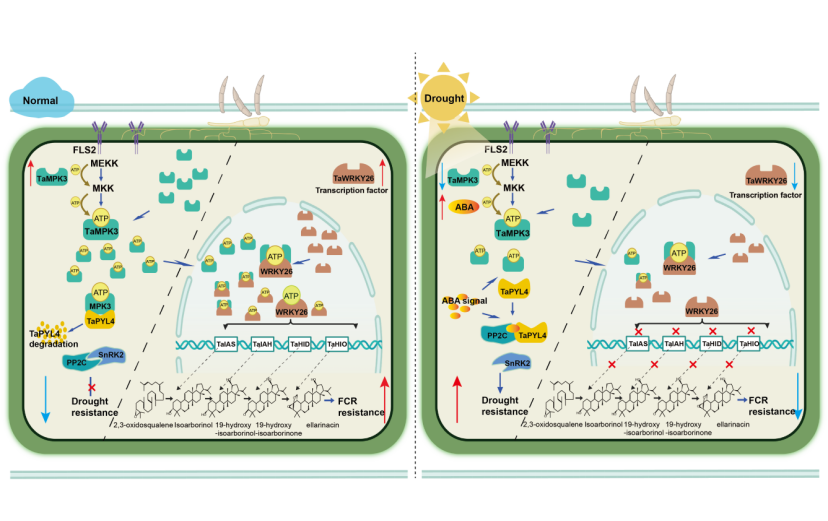
Crown rot has emerged as a major wheat disease in recent years. Its concealed onset, prolonged damage, and limited availability of resistant germplasm make it difficult to control. Drought further aggravates the disease, but the molecular basis of this interaction has remained unclear.
Analysis of wheat gene data under drought and pathogen infection showed that pathogen invasion activates defense-related signaling genes, whereas drought markedly suppresses their activity. Among these genes, TaMPK3 enhances crown rot resistance but reduces drought tolerance. The team found that it modulates the activity of associated transcription factors and the synthesis of specific compounds in wheat, thereby regulating crown rot resistance. Knocking out TaMPK3 abolished the mutually reinforcing effects of drought and crown rot, confirming its role as a regulatory node linking drought responses with disease resistance. The study establishes a molecular model for the combined damage caused by the two stresses and provides a new target and theoretical basis for molecular breeding against wheat crown rot.
Zheng Lei, a postdoctoral researcher; Yu Taifei, an assistant research professor; and Liu Ying and Hou Zehao, doctoral graduates, at ICS-CAAS are co-first authors. Research professor Xu Zhaoshi is the corresponding author. The work was supported by the National Key Research and Development Program of China, the National Natural Science Foundation of China, a major agricultural biological breeding program, the Basic Research Center of the Agricultural Science and Technology Innovation Program of CAAS, and other programs.
Original paper: https://doi.org/10.1038/s41467-026-73123-y

Address:No.12 Zhongguancun South St.,Haidian
District, Beijing, P.R.China 100081
Tel: +86-10-82105813
Email:zkskyc@caas.cn
Fax:+86-10-82105819