
ICS-CAAS proposes a path for moving plant breeding from fields to factories
On July 20, the Crop Molecular Breeding Technology and Applications Innovation Team and the Crop Genomic Selection Technology and Applications Innovation Team at the Institute of Crop Sciences, Chinese Academy of Agricultural Sciences (ICS-CAAS), together with Chinese and international collaborators, published a perspective entitled “Revolution in Plant Breeding: From Field to Factory” in Molecular Plant. The article outlines a development path for plant breeding factories, providing a comprehensive theoretical framework and implementation route for overcoming the limitations of conventional breeding and transforming breeding practice.
As global climate change intensifies, extreme weather, abiotic stresses, diseases, and insect pests are becoming increasingly frequent. Conventional breeding relies on multi-year, multi-location trials to select superior genotypes and identify suitable growing regions. Its long timelines and high costs make it difficult to respond rapidly to national needs for stable food production and stronger independent innovation in the seed industry. A disruptive breeding technology system is therefore urgently needed.
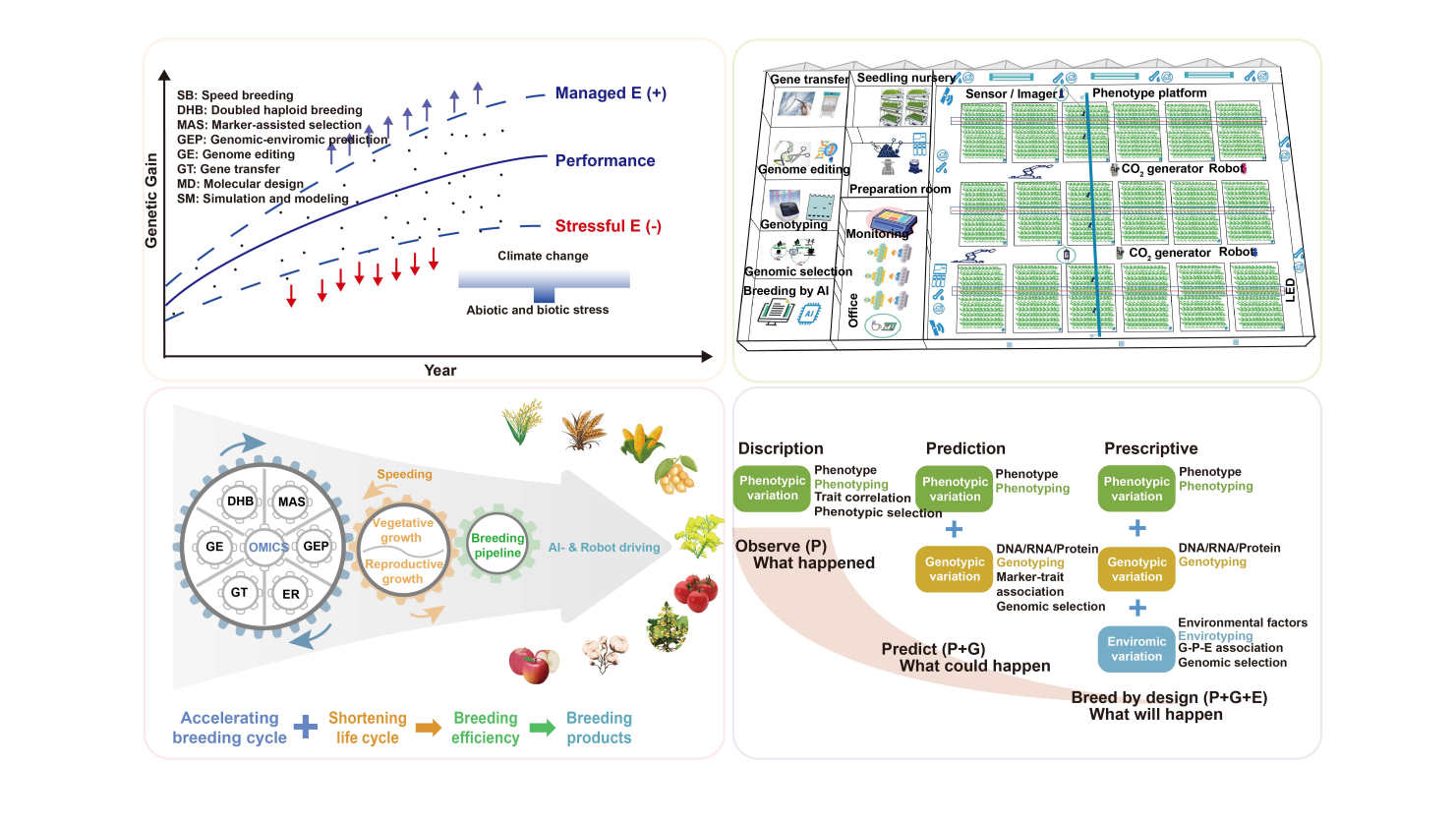
The proposed plant breeding factory system integrates modern breeding technologies, enviromics, big data, and intelligent breeding models. Most breeding activities would be moved into controlled environments, with only a small number of selected materials entering target fields for final evaluation. At present, the system can complement conventional field breeding by supporting rapid generation advancement, selection of stress-adapted materials, and pyramiding of favorable alleles under controlled conditions. Genotype-phenotype-environotype data and breeding models would also enable precise prediction of performance across production regions. The system could substantially shorten breeding cycles and shift breeding from field selection dependent on natural conditions toward precise prediction in controlled factory environments.
Fu Junjie, a research professor at ICS-CAAS, and Tan Cong, a researcher at Shenzhen BGI-Wanwu Technology Co., Ltd., are co-first authors. Research professors Xu Yunbi and Fu Junjie at ICS-CAAS; Professor Richard G. F. Visser at Wageningen University, the Netherlands; and research professor Yang Qichang at the Institute of Urban Agriculture, CAAS, are co-corresponding authors. The work was supported by Shenzhen science and technology innovation programs, the National Key Research and Development Program of China, the Agricultural Science and Technology Innovation Program of CAAS, and other programs.
Original paper: https://www.sciencedirect.com/science/article/abs/pii/S1674205226002364

Address:No.12 Zhongguancun South St.,Haidian
District, Beijing, P.R.China 100081
Tel: +86-10-82105813
Email:zkskyc@caas.cn
Fax:+86-10-82105819