
ICS-CAAS constructs the world's first mung bean graph pangenome
On July 10, the Innovation Team for Exploration and Innovative Utilization of Elite Germplasm Resources in Specialty Crops at the Institute of Crop Sciences, Chinese Academy of Agricultural Sciences (ICS-CAAS), together with Chinese and international collaborators, constructed the world's first high-quality mung bean graph pangenome. The team elucidated molecular mechanisms through which structural variation regulates flavonoid biosynthesis and bruchid resistance in mung bean. The findings were published in Nature Genetics.

Mung bean is an important specialty pulse crop in China. Its short growth duration, broad adaptation, high-quality protein, and bioactive flavonoids make it valuable for food diversity, dietary nutrition, and sustainable agriculture. Previous reliance on a single reference genome could not fully capture mung bean genetic diversity. Substantial missing heritability for complex agronomic traits, including yield, quality, and stress resistance, has long constrained genetic improvement and industry development.
The researchers assembled a collection of 580 mung bean accessions representing diverse ecological regions and genetic backgrounds. They selected 11 representative wild accessions, landraces, and modern cultivars for genome assembly and constructed the world's first mung bean graph pangenome. Systematic analysis then produced a high-resolution map containing 65,535 structural variants. Wild mung bean retained numerous unique structural variants that were significantly enriched in gene regulatory regions and contributed to domestication, environmental adaptation, and key agronomic traits. Some of these variants had gradually been lost during domestication. The findings show that structural variation both records mung bean domestication history and provides important clues for identifying genetic resources relevant to environmental adaptation and germplasm innovation.
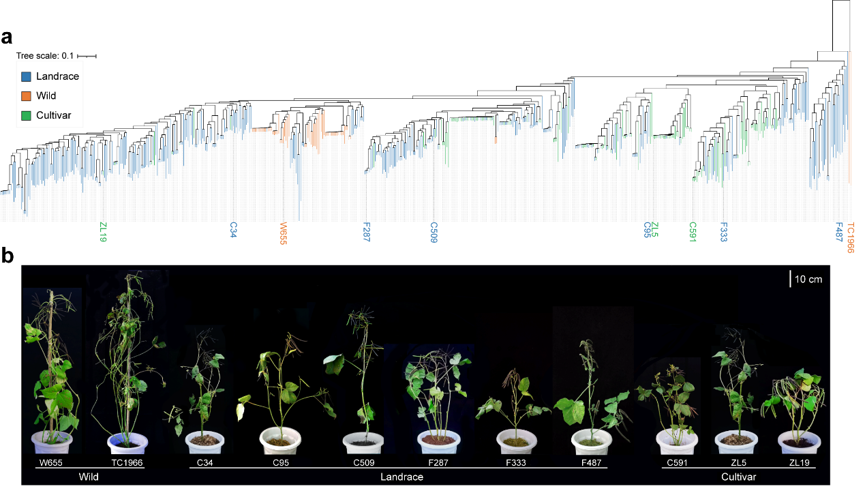
Figure 1. Construction of the world's first mung bean graph pangenome and characterization of structural variation resources.
The team incorporated structural variation into the analysis of complex agronomic traits by establishing a graph pangenome-based framework for structural variant genome-wide association studies. Joint association analyses of 20 important agronomic traits confirmed that both structural variants and single-nucleotide variants form a central genetic basis for complex traits. This advances crop genetic analysis from a predominantly single-nucleotide-based approach toward the joint analysis of both variant classes.
Using this framework, the team identified VrTIFY6B and VrPGIP1 as key genes controlling flavonoid biosynthesis and bruchid resistance. A promoter insertion and coding-region mutations in VrTIFY6B regulate flavonoid accumulation through a mechanism consistent with that found in buckwheat. A promoter deletion in VrPGIP1 enhances gene expression, inhibits the activity of a key degradative enzyme, and maintains seed coat integrity, thereby strengthening insect resistance. This study fills a gap in mung bean graph pangenome research and provides important targets and theoretical support for breeding high-quality, insect-resistant varieties.
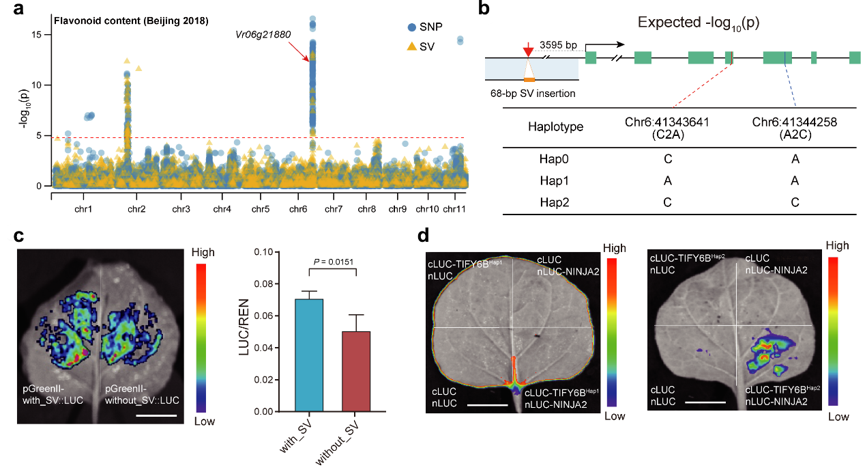
Figure 2. Molecular mechanism by which structural variation in VrTIFY6B regulates flavonoid accumulation in mung bean.
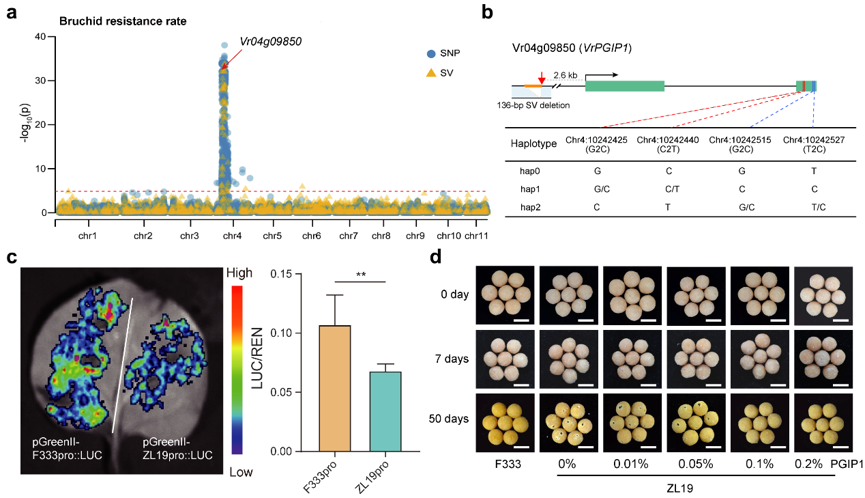
Figure 3. Molecular mechanism by which structural variation in VrPGIP1 regulates bruchid resistance in mung bean.
Chen Honglin, an associate research professor at ICS-CAAS; Xing Longsheng, a university-appointed research professor at Hebei University; and Guan Chaonan, a postdoctoral researcher, and Liu Yang, a doctoral student, at ICS-CAAS, are co-first authors. Associate research professor Chen Honglin and research professors Cheng Xuzhen and Zhou Meiliang at ICS-CAAS; Professor Rajeev Varshney at Murdoch University, Australia; Professor Du Huilong at Hebei University; and research professor Jiao Chengzhi at the Institute of Advanced Agricultural Sciences, Peking University, are co-corresponding authors. The work was supported by the National Natural Science Foundation of China, the China Agriculture Research System, the Agricultural Science and Technology Innovation Program of CAAS, and other programs.
Original paper: https://doi.org/10.1038/s41588-026-02644-5

Address:No.12 Zhongguancun South St.,Haidian
District, Beijing, P.R.China 100081
Tel: +86-10-82105813
Email:zkskyc@caas.cn
Fax:+86-10-82105819