
Decoding the noncoding rice genome reveals new breeding potential
Published 8 April 2026 | Source article
On April 6, the Wild Rice Conservation and Utilization Innovation Research Group at the Institute of Crop Sciences, Chinese Academy of Agricultural Sciences (ICS-CAAS), together with Chinese and international research teams, systematically characterized the multi-omics features and phenotypic effects of long noncoding RNAs in rice. The study revealed their contributions to phenotypic variation and their breeding potential. The findings were published in Cell Research.
Noncoding regions of the rice genome contribute to growth and development, environmental adaptation, and agronomic traits. However, previous research has largely focused on protein-coding genes, leaving the broader functions of long noncoding RNAs in rice phenotypic variation and breeding value insufficiently understood.
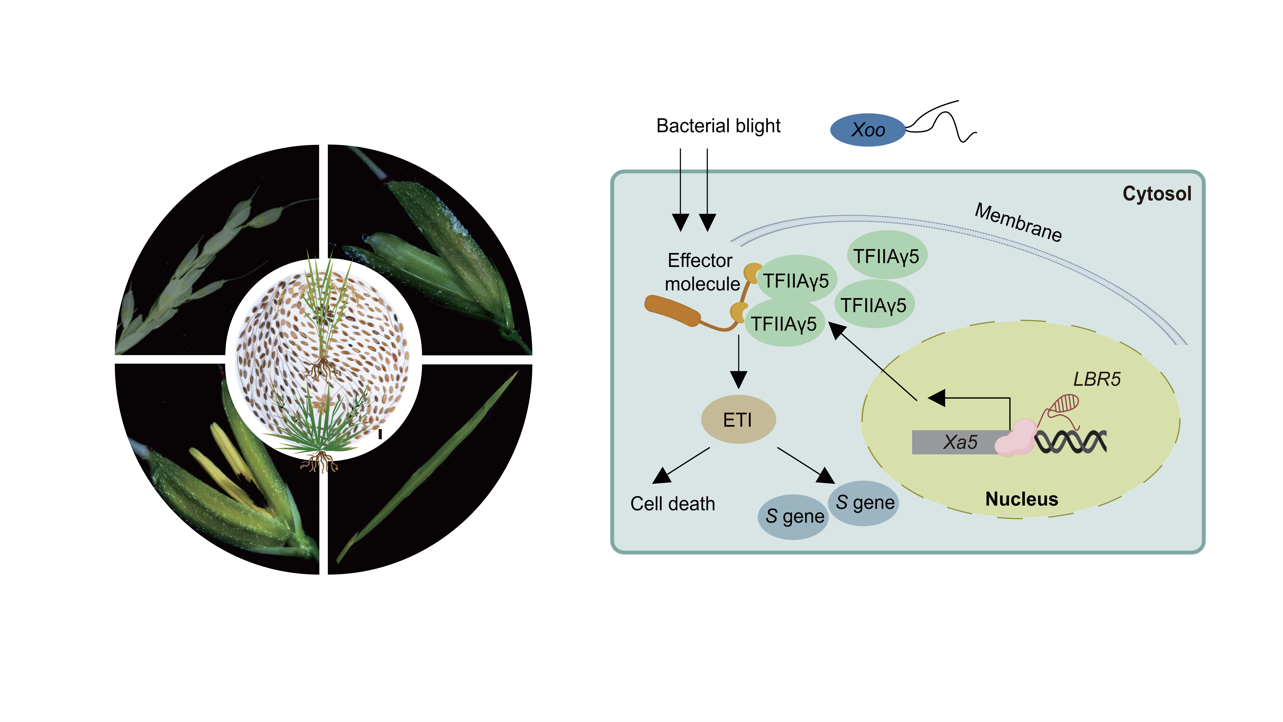
The researchers identified 57,162 high-confidence long noncoding RNAs in a large collection of rice samples. They produced the first functional atlas spanning both wild and cultivated rice and established a framework linking these RNAs to agronomic traits. Among more than 80,000 genomic loci associated with 32 important rice agronomic traits, 4,427 occurred in regions corresponding to 1,530 long noncoding RNAs. Their genetic contributions to traits were comparable to those of protein-coding genes. The team also mapped and validated a key long noncoding RNA involved in bacterial blight resistance. The study supports a transition from resource annotation to functional analysis of the rice noncoding genome and the discovery of new breeding targets.
Gao Ge and Li Yunpeng, doctoral students, and Lou Danjing, a master's graduate, affiliated with the State Key Laboratory of Crop Gene Resources and Breeding and ICS-CAAS, are co-first authors. Academician Qian Qian and research professor Zheng Xiaoming at ICS-CAAS, and Professor Kenneth M. Olsen at Washington University in St. Louis, USA, are co-corresponding authors. The work was supported by the Hainan Provincial Key Research and Development Program, the National Key Research and Development Program of China, and the National Natural Science Foundation of China.
Original paper: https://doi.org/10.1038/s41422-026-01247-3

Address:No.12 Zhongguancun South St.,Haidian
District, Beijing, P.R.China 100081
Tel: +86-10-82105813
Email:zkskyc@caas.cn
Fax:+86-10-82105819