
ICS-CAAS builds a Tartary buckwheat pangenome and uncovers genetic routes to improving high-altitude adaptation and yield
On August 11, a team led by research professor Zhou Meiliang at the Institute of Crop Sciences, Chinese Academy of Agricultural Sciences (ICS-CAAS), together with Chinese and international collaborators, constructed a Tartary buckwheat pangenome encompassing Himalayan wild accessions and landraces from around the world. The researchers identified and combined favorable alleles controlling high-altitude adaptation and grain size, creating new germplasm with both high-altitude adaptation and high yield potential. The findings were published in Cell.
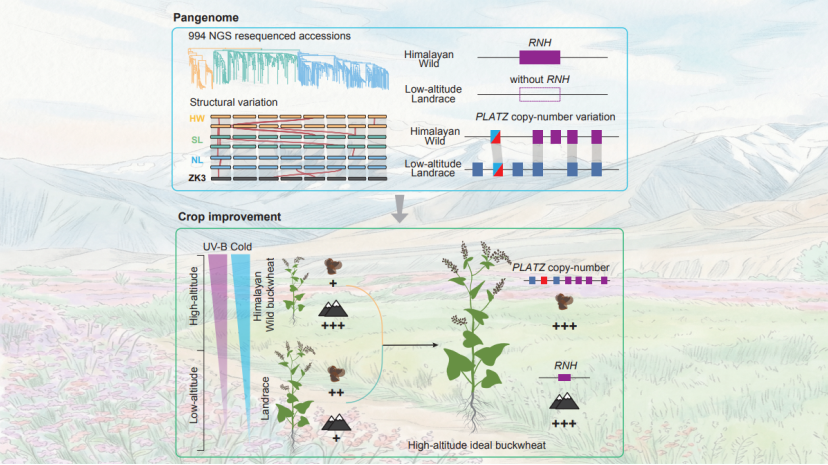
According to Zhou Meiliang, Tartary buckwheat originated in the Himalayas and is an important food crop in cool, high-altitude mountain regions. Rich in flavonoids and other bioactive compounds, it contributes to local food and nutritional security and the development of specialty crop industries. However, intense ultraviolet radiation and low temperatures in the Himalayas impose combined stresses on crop growth, exacerbating the difficulty of achieving both stress tolerance and high yield. Overcoming this breeding bottleneck to develop high-yielding, high-quality germplasm suited to high altitudes is therefore a pressing priority for the Tartary buckwheat industry.
Building a Tartary buckwheat pangenome to recover genetic determinants of high-altitude adaptation
Over more than a decade, the team surveyed, collected, characterized, and conserved wild buckwheat resources across central and western China and the Himalayan region. They collected more than 2,000 wild accessions and established a broad picture of wild buckwheat distribution in China. Alongside this work, sustained efforts to use elite germplasm and develop new varieties led to Zhongku 3, a Tartary buckwheat variety with broad adaptation and high, stable yield. Using 16 representative accessions, including Zhongku 3, the team then constructed a pangenome and integrated genetic variation data from 994 accessions across 15 countries and regions to generate a high-resolution variation map. Himalayan wild Tartary buckwheat retained greater genetic diversity and more unique structural variants, providing resources for recovering adaptation genes lost during domestication and identifying loci for yield improvement.
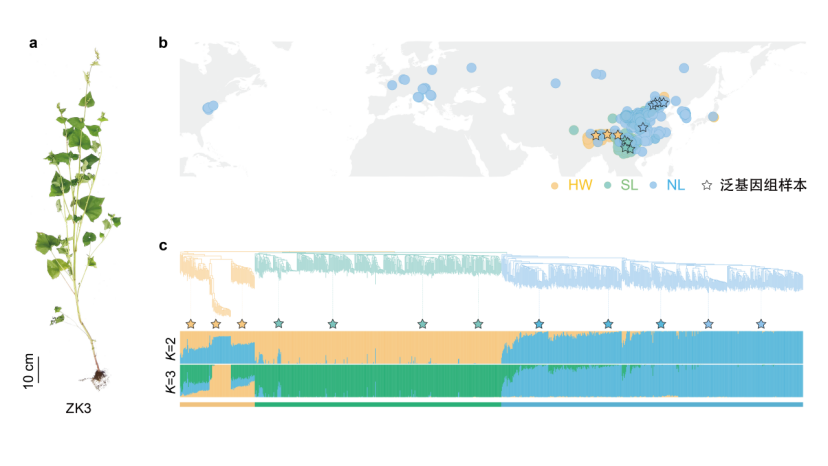
Figure 1. Construction of the Tartary buckwheat pangenome and a high-resolution variation map.
Identifying key targets for high-yield breeding to address industry needs
Among structural variants specific to wild Tartary buckwheat, the team identified FtRNH, a gene lost in cultivated Tartary buckwheat. This gene removes excessive abnormal nucleic acid structures that interfere with normal gene expression, reducing DNA damage caused by ultraviolet radiation and low temperatures and thereby improving high-altitude adaptation.
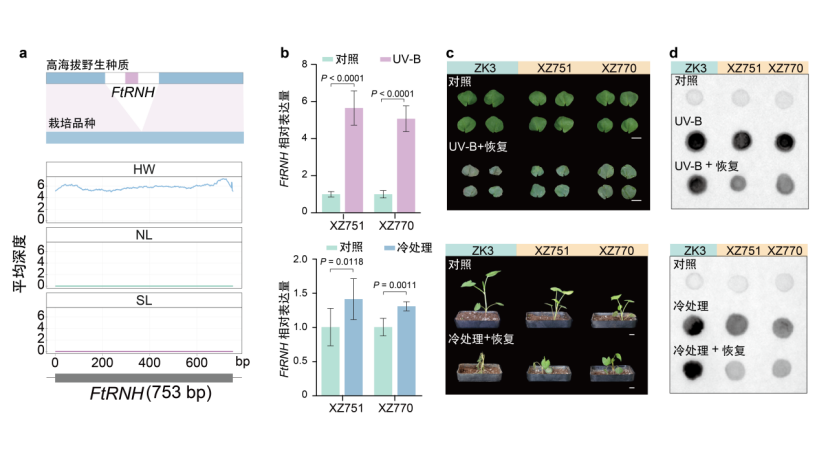
Figure 2. FtRNH improves high-altitude adaptation in Tartary buckwheat.
The team also identified FtPLATZ3, a gene controlling grain size. Both an insertion in its promoter and an increase in the copy number of homologous genes in the FtPLATZ family promoted larger grains, providing important targets for high-yield breeding.
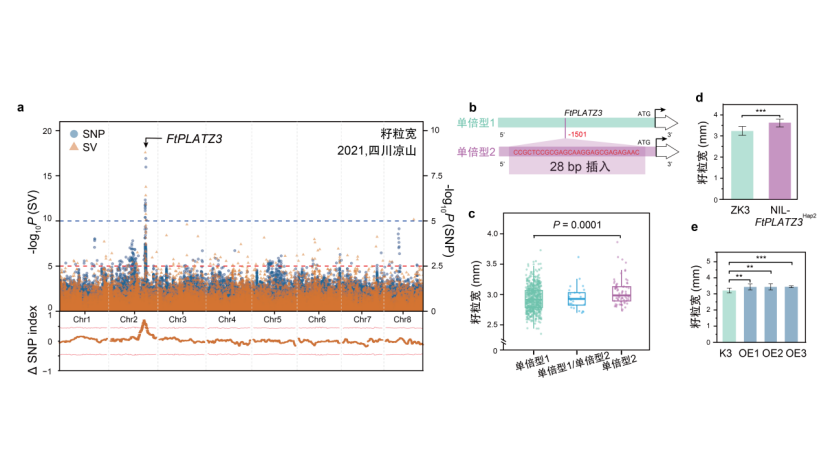
Figure 3. Promoter variation in FtPLATZ3 regulates grain size in Tartary buckwheat.
Combining favorable genes to establish a new breeding route
The researchers combined FtRNH from wild Tartary buckwheat, a large-grain FtPLATZ3 haplotype from landraces, and additional FtPLATZ homolog copies through crossing, backcrossing, and marker-assisted selection. The resulting germplasm combined high-altitude adaptation with large grains and high yield, yielding approximately 25% more than the control variety under high-altitude conditions. The study establishes a new route for precision breeding of Tartary buckwheat for high-altitude environments and for using favorable genes from wild relatives in other crops.
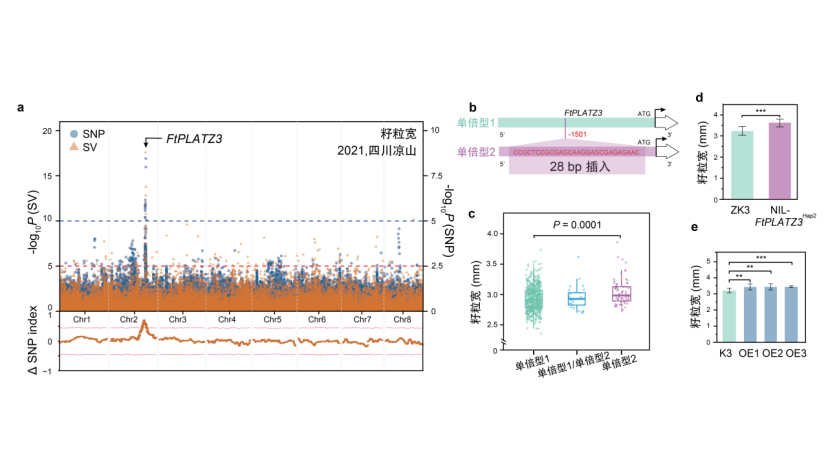
Figure 4. Development of new Tartary buckwheat germplasm combining high-altitude adaptation, large grains, and high yield.
Research professor Zhang Kaixuan, associate research professor He Yuqi, and doctoral graduates Lin Hao and He Jiayue at ICS-CAAS, among others, are co-first authors. Research professor Zhou Meiliang, Academician Liu Xu, and associate research professor He Yuqi at ICS-CAAS; Professor Liu Jianquan at Lanzhou University; and Professor Rajeev Varshney at Murdoch University, Australia, are co-corresponding authors. The work was supported by the National Natural Science Foundation of China, the Youth Innovation Program of CAAS, science and technology programs of the Xizang Autonomous Region, the SHENG program of Poland's National Science Centre, the Asian Cooperation Fund, and other programs.
Original paper: https://www.cell.com/cell/fulltext/S0092-8674(26)00867-6

Address:No.12 Zhongguancun South St.,Haidian
District, Beijing, P.R.China 100081
Tel: +86-10-82105813
Email:zkskyc@caas.cn
Fax:+86-10-82105819