
ICS-CAAS reveals a new mechanism linking the circadian clock to latitudinal adaptation in soybean
On September 8, the Soybean Breeding Technology Innovation and New Variety Development Team and the Big Data and Intelligent Breeding by Design Team at the Institute of Crop Sciences, Chinese Academy of Agricultural Sciences (ICS-CAAS), revealed how the key maturity gene GmRVE4d regulates flowering, maturity, and latitudinal adaptation in soybean. The findings were published in Nature Communications.
Soybean is a typical short-day crop with strong photoperiod sensitivity. The timing of flowering and maturity strongly influences its environmental adaptation. Circadian clock genes are central regulators of photoperiod responses: they integrate environmental signals and coordinate external cues with internal developmental processes. However, how these components regulate growth duration and latitudinal adaptation has remained unclear.
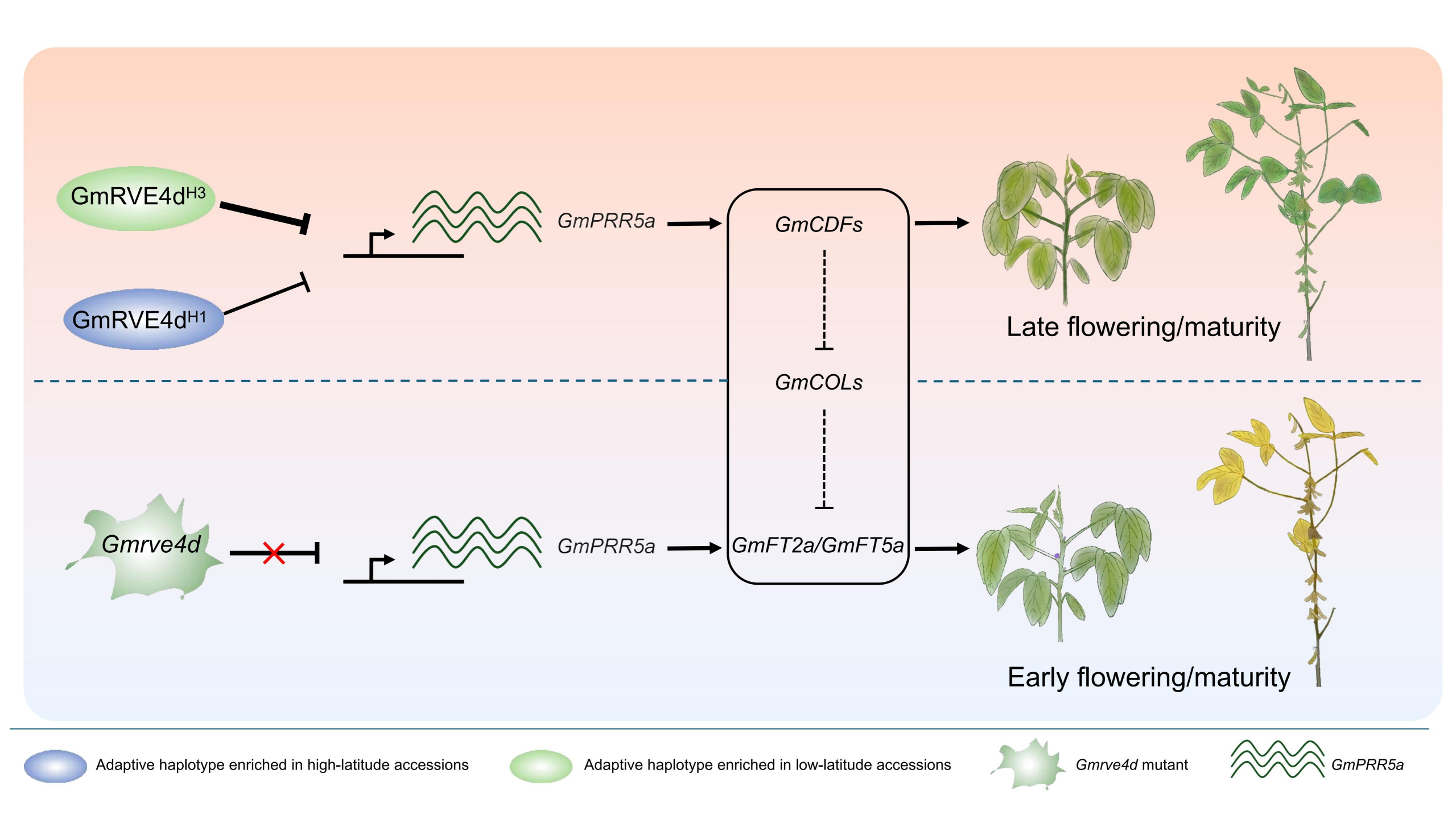
Using soybean germplasm from different maturity groups and an integrated analytical approach, the team cloned the key maturity gene GmRVE4d. Knocking out this gene substantially advanced flowering and maturity, whereas overexpression delayed both. Further experiments showed that GmRVE4d directly binds to and represses the transcription of core circadian clock genes, reducing the expression of flowering-promoting genes and consequently delaying flowering and maturity. Population analysis identified domestication-associated natural variation in GmRVE4d: late-maturing haplotypes were enriched at southern, lower latitudes, whereas early-maturing haplotypes were more common at northern, higher latitudes. The study provides a new molecular target for adjusting soybean growth duration and extending its cultivation range.
Sun Baiquan, a postdoctoral researcher, and associate research professors Wu Tingting and Jiang Bingjun at ICS-CAAS are co-first authors. Research professors Han Tianfu, Sun Shi, and Li Huihui are co-corresponding authors. The work was supported by the National Key Research and Development Program of China, a joint science and technology innovation program of Hainan Province and Sanya Yazhou Bay, a Hainan provincial postdoctoral research program, and other programs.
Original paper: https://doi.org/10.1038/s41467-026-77316-3

Address:No.12 Zhongguancun South St.,Haidian
District, Beijing, P.R.China 100081
Tel: +86-10-82105813
Email:zkskyc@caas.cn
Fax:+86-10-82105819