
Three genes work together to improve drought tolerance in rice
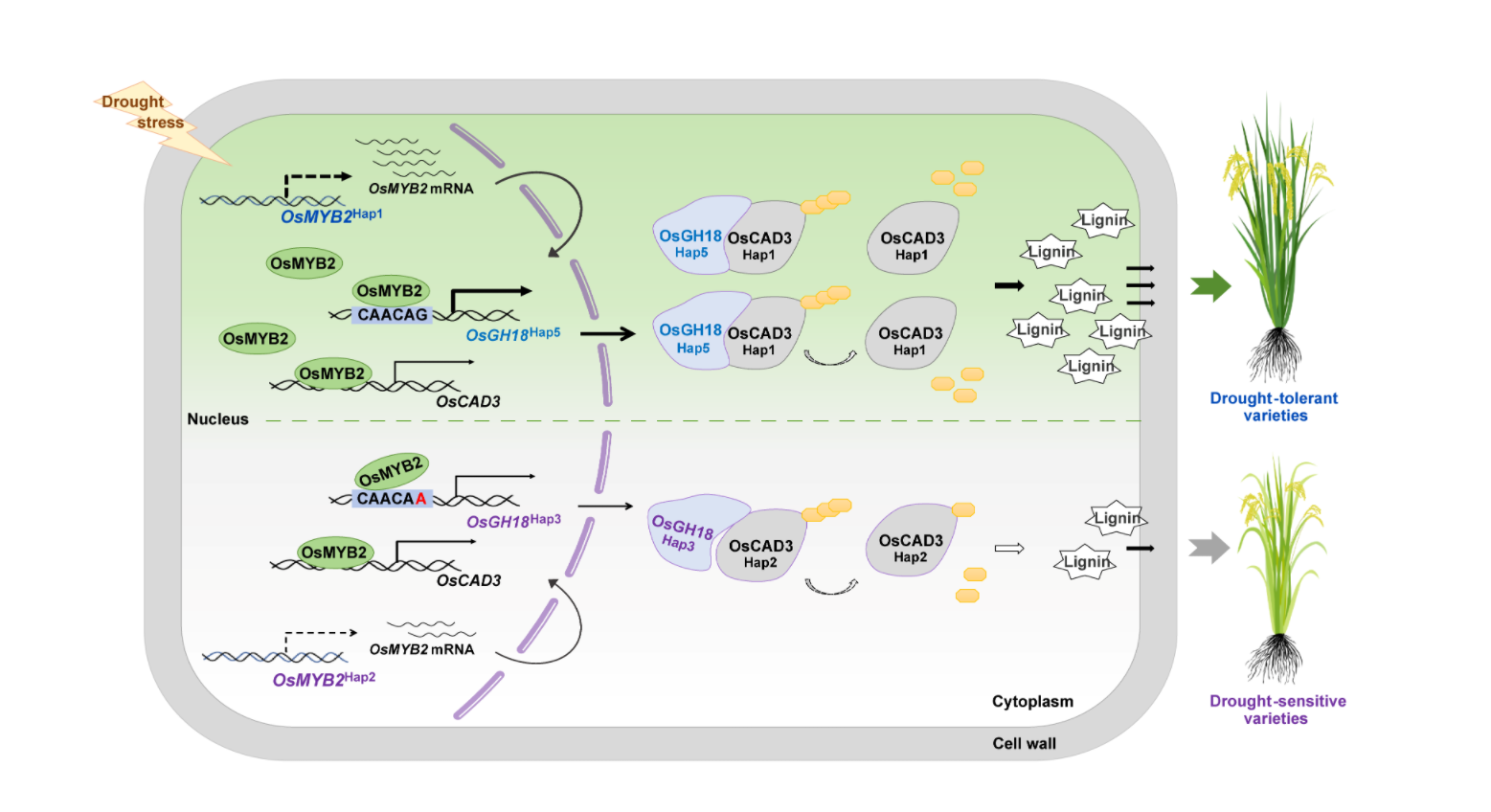
On January 20, the Rice Molecular Design Technology and Applications Innovation Team at the Institute of Crop Sciences, Chinese Academy of Agricultural Sciences (ICS-CAAS), cloned and systematically characterized three interacting drought-tolerance genes, OsMYB2, OsGH18, and OsCAD3. The researchers revealed how the genes jointly regulate drought tolerance throughout the rice life cycle by controlling lignin biosynthesis and strengthening cell walls. The findings were published in Molecular Plant.
Water scarcity and frequent drought pose serious threats to rice production, making improved drought tolerance essential. Drought tolerance is controlled by multiple genes. Although several relevant genes have been cloned, limited integration with population genetic parameters has restricted the number of gene resources that can be directly used in breeding. Lignin synthesis and accumulation in plant cell walls are also closely linked to drought tolerance, but the associated regulatory network and mechanisms remain unclear.
Using 408 core accessions, the team identified OsMYB2, OsGH18, and OsCAD3 through genome-wide association analysis. Under drought stress, the transcription factor OsMYB2 positively regulates the expression of the other two genes. The glycoside hydrolase OsGH18 activates cinnamyl alcohol dehydrogenase OsCAD3 through hydrolysis, promoting lignin synthesis and cell wall thickening and thereby improving water retention and drought tolerance. Further analysis identified multiple natural allelic variants in all three genes and significant epistatic interactions among different allele combinations. The genes form a functional module that jointly regulates lignin accumulation. A genetic model based on these interactions efficiently predicted drought-tolerance ratings, relative plant height under drought, and yield traits in rice populations and identified valuable donor materials for drought-tolerance breeding. The study provides important targets and new ideas for integrating genomic data with artificial intelligence to design drought-tolerant rice germplasm.
Huo Mingyue, a postdoctoral researcher at ICS-CAAS; Wang Shanwen, a doctoral student at Yunnan University; Zhang Fan, a research professor at ICS-CAAS; and Li Min, a professor at Anhui Agricultural University, are co-first authors. Prof. Wang Wensheng, Deputy Director General of ICS-CAAS, and research professors Li Zhikang and Xu Jianlong at ICS-CAAS are co-corresponding authors. The work was supported by the STI 2030 Major Projects, the Agricultural Science and Technology Innovation Program of CAAS, the National Special Support Program for High-Level Talent, the CAAS Nanfan Special Project, and other programs.
Original paper: https://doi.org/10.1016/j.molp.2026.01.005

Address:No.12 Zhongguancun South St.,Haidian
District, Beijing, P.R.China 100081
Tel: +86-10-82105813
Email:zkskyc@caas.cn
Fax:+86-10-82105819