
ICS‑CAAS Hosted International Atomic Energy Agency Asia‑Pacific Regional Nuclear Agriculture Project Coordination Meeting in Beijing
From November 9 to 13, the Coordination Meeting for crop mutation breeding under the IAEA Technical Cooperation Project RAS5102: Promoting Resilient and Sustainable Agrifood Systems through Innovative Nuclear and Related Techniques convened in Beijing. The event was organized by the International Atomic Energy Agency (IAEA), and co‑hosted by the China Atomic Energy Authority (CAEA) and the Institute of Crop Sciences (ICS), Chinese Academy of Agricultural Sciences (CAAS).
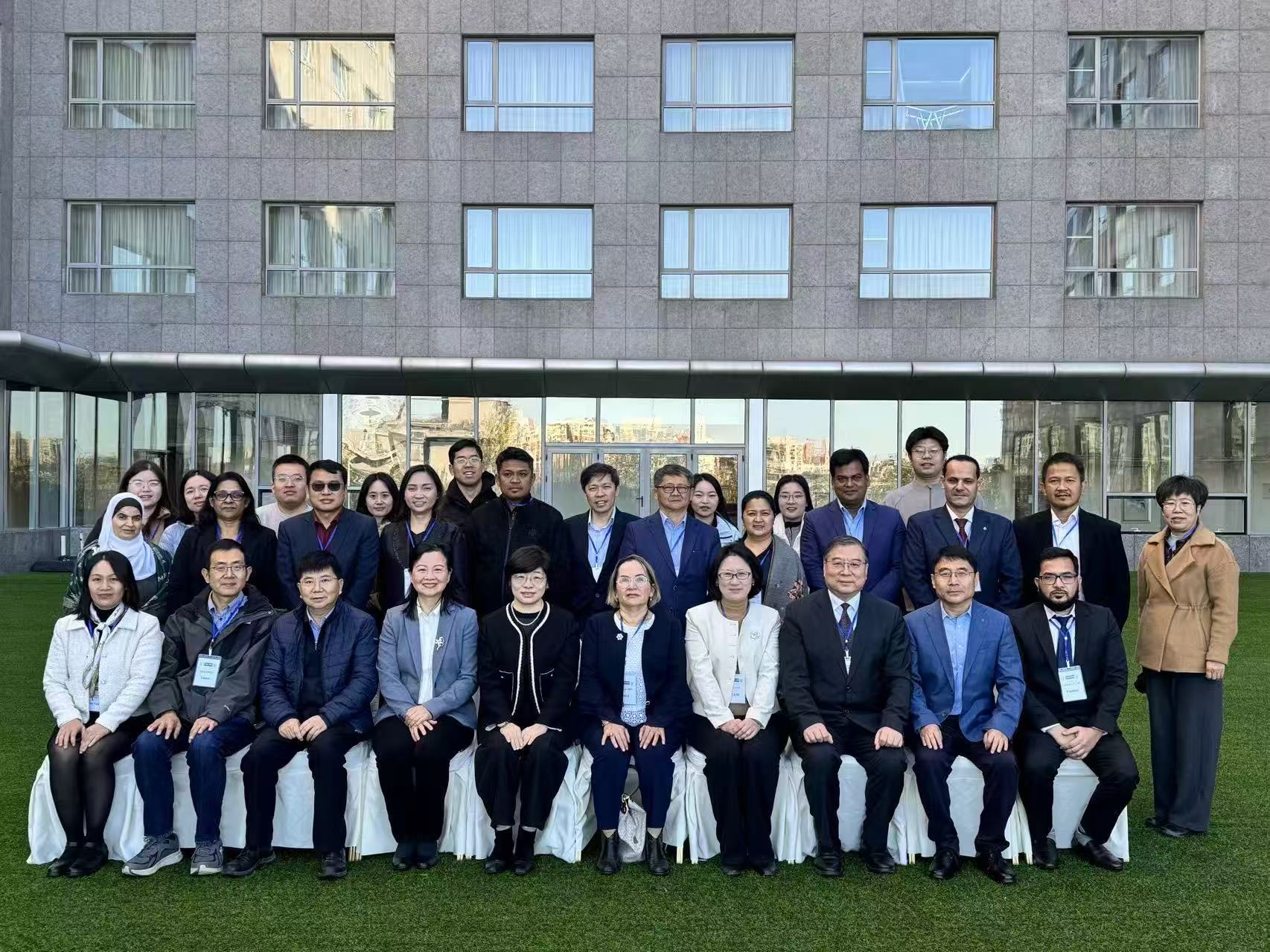
Ms. Yang Lin, Project Management Officer of IAEA TC Department, Ms. Fatma Sarsu, Technical Officer of Joint FAO/IAEA Center, together with project counterparts from 15 IAEA Member States including Bangladesh, China, Indonesia, Jordan, Lao P.D.R., Malaysia, Mongolia, Myanmar, Pakistan, Philippines, Qutar, Sri Lanka, Thailand and Vietnam attended the meeting. Ms. Xiao Lili, Division Director of CAEA Department of International Cooperation; Ms. Zhai Lin, Deputy Director‑General of CAAS Department of International Cooperation; and Mr. Wang Wensheng, Deputy Director‑General of ICS‑CAAS, were present at the opening ceremony and delivered opening remarks. The meeting was chaired by Prof. Liu Luxiang, former Party Secretary of ICS‑CAAS and the Designated Team Member for project RAS5102.
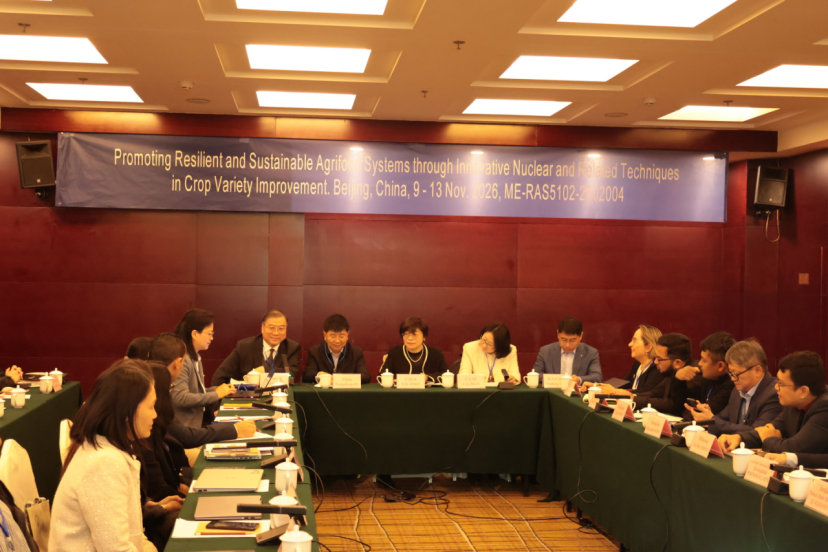
Participants held in‑depth exchanges and discussions focusing on climate‑smart crop mutation breeding, mutant germplasm creation, technical‑system optimization and regional capacity‑building. Delegates from each Member States reported national progress and technical demands for mutation‑breeding research. Common technical bottlenecks across the Asia‑Pacific region were identified: high‑throughput phenotyping for mutants, bioinformatic analysis, professional talent pool for induced mutagenesis, and cross‑border exchange & cooperation of mutant germplasm resources.
The meeting defined the key activities for the 2027–2028 period, and will continue to advance regional training on mutation breeding, workshops on key technologies, expert missions on capacity building, sharing and exchange of elite mutant germplasm Synergies will be fostered with other RAS5102 thematic components: food irradiation processing, food safety, nutrition and health. These actions aim to accelerate deployment of advanced induced‑mutation breeding technologies and outputs across the Asia‑Pacific region.
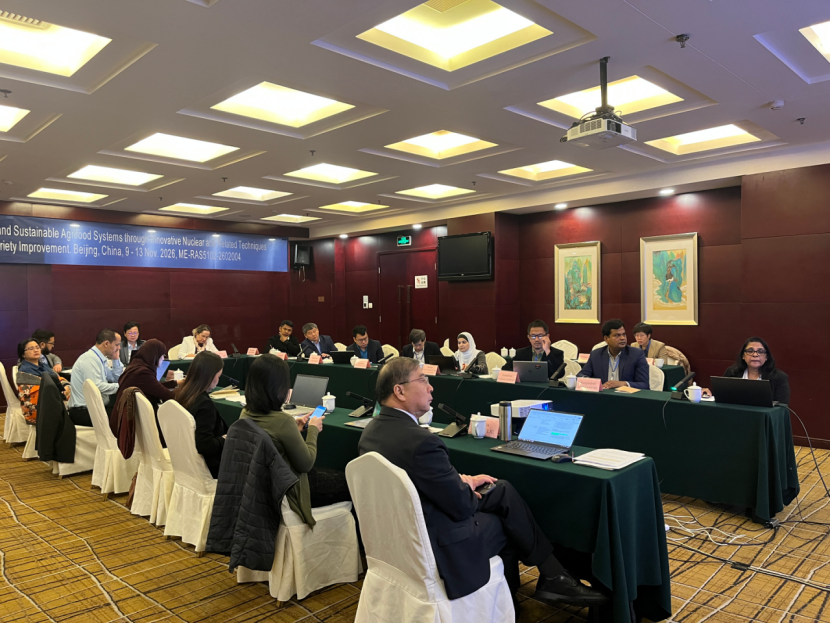
Invited keynote speakers included Academician Fu Xiangdong (Institute of Genetics and Developmental Biology, CAS); Prof. Zhou Libin (Institute of Modern Physics, CAS); Prof. Xin Mingming (China Agricultural University); Prof. Qiu Lijuan and Prof. Diao Xianmin (ICS‑CAAS). They presented China’s cutting‑edge advances in crop nitrogen‑efficiency improvement, abiotic‑stress‑tolerant breeding, high‑efficiency heavy‑ion mutagenesis and elite germplasm innovation. After the formal sessions, foreign delegates visited the at the China Institute of Atomic Energy to inspect high‑energy heavy‑ion irradiation facilities for crop mutagenesis.
It is noted that in October 2023, the IAEA and FAO jointly launched the flagship global initiative Atoms4Food at the World Food Forum in Rome. Drawing on nearly six decades of joint experience in nuclear technology for agriculture, the initiative deploys nuclear and interdisciplinary frontier technologies to help Member‑States tackle major challenges: food security, agricultural development and climate‑change adaptation. It drives transformation of global agrifood systems in support of the UN Sustainable Development Goals.
Against this backdrop, the Chinese scientist Professor Liu Luxiang, as the Designated Team Member led the conceptual design of RAS5102, integrated the four directions of mutation breeding, food irradiation, food safety, and nutrition and health, organized Member States in the Asia-Pacific region, and proposed a joint programme, which was approved by IAEA as RAS5102 in November 2025. The programme has a four-year implementation period (2026–2029) and will promote innovative applications of nuclear technology through a series of training and capacity-building activities, strengthen the transformation capacity of sustainable agrifood systems at both member state and regional levels, enhance crop productivity, improve nutritional status, and ensure food safety.
Over the years, the mutation breeding team of ICS-CAAS has been deeply engaged in innovative research on nuclear technology applications in crop improvement, and has continuously led IAEA Asia-Pacific regional technical cooperation projects. The launch of the RAS5102 crop mutation‑breeding component will further disseminate China’s advanced mutation breeding techniques, R&D frameworks and mutant varieties throughout Asia‑Pacific. It supports the development of high‑yielding, stress‑resilient and climate‑adapted new crop cultivars, enhances the resilience of Asian agrifood systems, and contributes Chinese expertise and solutions toward global food security and sustainable agriculture.

Address:No.12 Zhongguancun South St.,Haidian
District, Beijing, P.R.China 100081
Tel: +86-10-82105813
Email:zkskyc@caas.cn
Fax:+86-10-82105819